
How Our UK Bra Size Calculator Works
Our UK Bra Size Calculator is designed to give you a practical starting bra size from your underbust and full bust measurements.
The calculator separates the process into two main calculations:
- determine a starting UK band size from your underbust and
- use the difference between your full bust and actual underbust to estimate your starting cup size.
It then combines the band and cup to produce a result such as 32DD or 34D.
Breast shape is used separately to help personalise bra-style recommendations. It does not change the core band-and-cup calculation.
If you want to calculate your size now, use our Bra Size Calculator.
What the Calculator Is Designed to Do
A bra-size calculator cannot guarantee that every bra with the calculated label will fit perfectly.
Its job is to give you a consistent starting size based on your measurements.
You can then use that result to:
- choose a starting band and cup size
- compare nearby sister sizes
- understand international size equivalents and
- try bras and assess the actual fit.
Bra construction, fabric, brand sizing and individual body shape can all affect how a particular bra feels.
So the result should be treated as a starting point for fitting, rather than a promise that every bra in that size will fit identically.
What Information Does the Calculator Use?
The calculator asks for four pieces of information.
1. Measurement Unit
You can choose:
- inches; or
- centimetres.
Use the same unit for both your underbust and full bust measurements.
You do not need to convert centimetres into inches yourself before using the calculator.
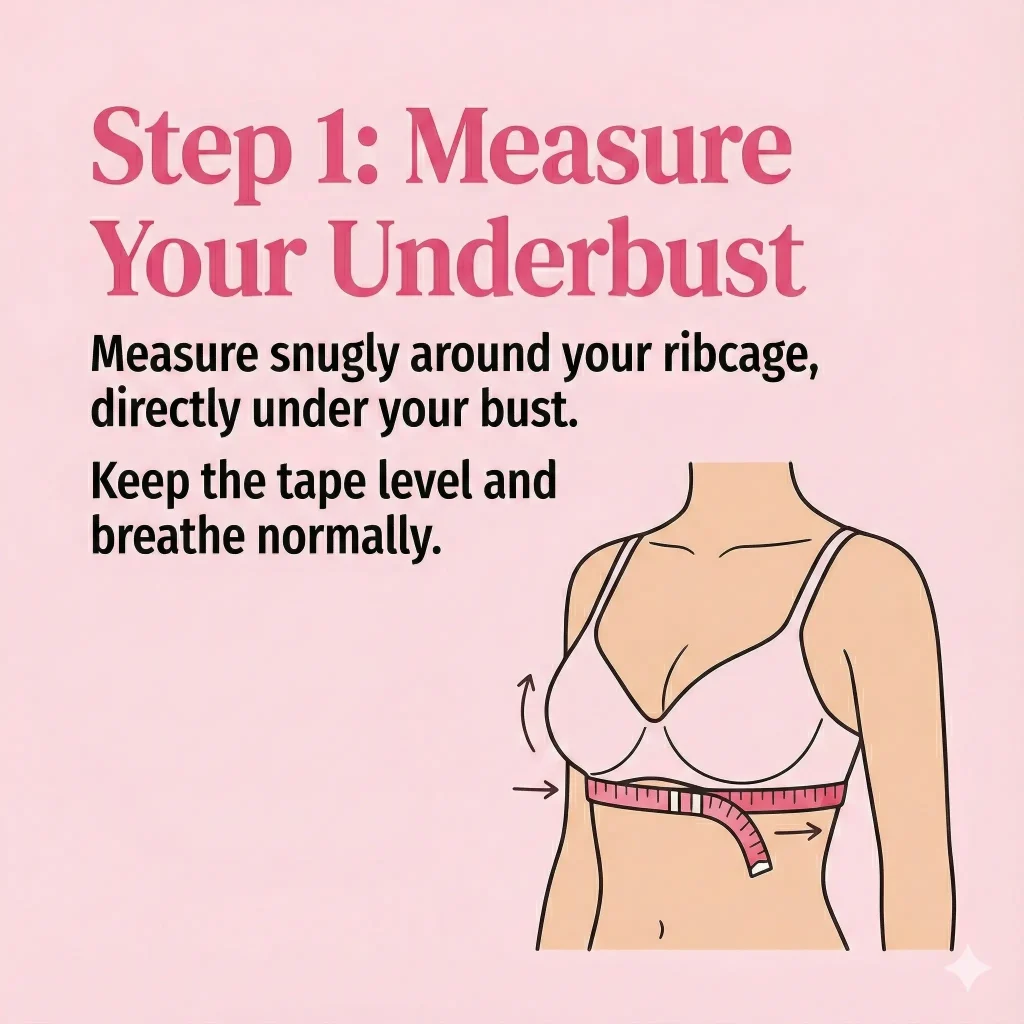
2. Underbust Measurement
Your underbust is measured around your ribcage directly beneath your bust.
This measurement is used to determine your starting band size.
3. Full Bust Measurement
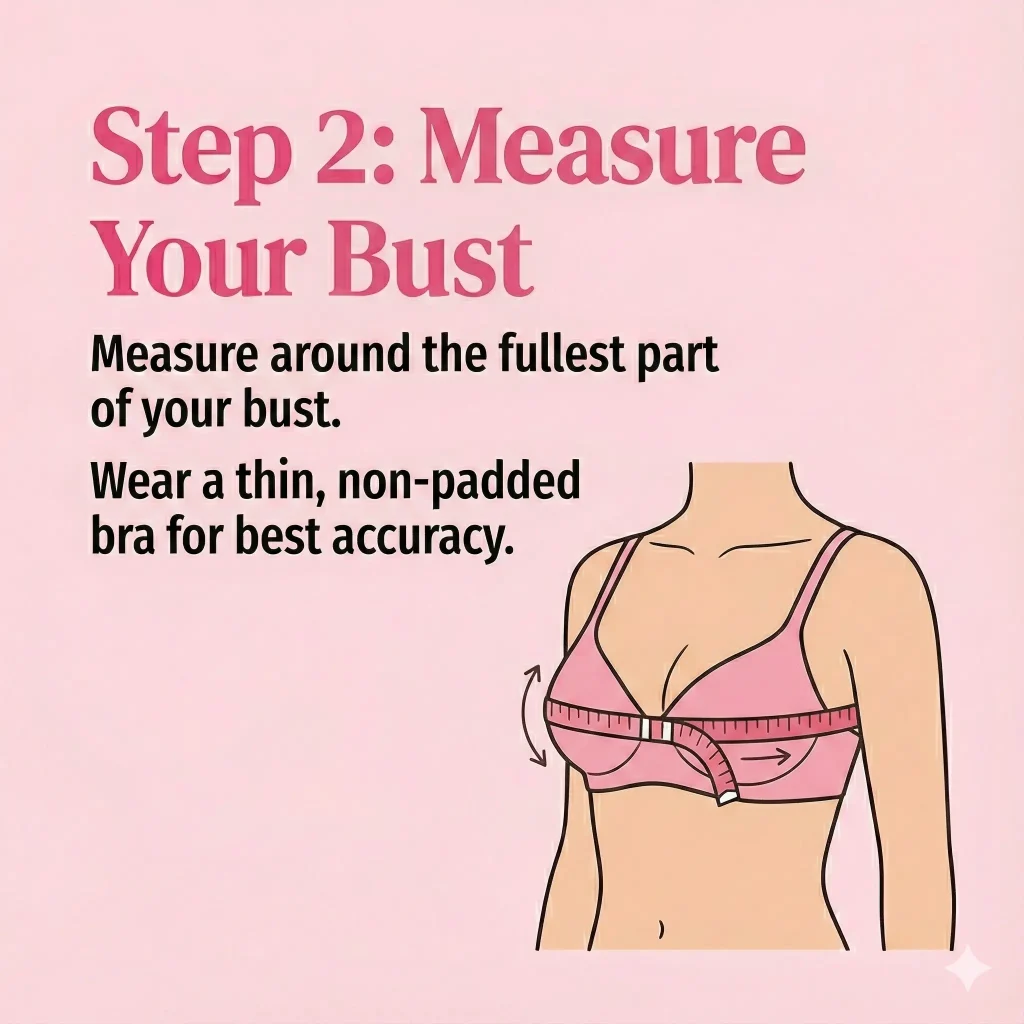
Your full bust is measured around the fullest part of your bust.
The difference between the full bust and actual underbust measurements is used to estimate your starting cup size.
4. Breast Shape
The calculator also asks you to select your breast shape.
Breast shape is used to personalise bra-style recommendations after the size calculation.
It does not alter the core calculated band or cup size.
If you need help taking the measurements correctly, follow our How to Measure Bra Size guide first.
How Your UK Bra Size Is Calculated
The core calculation happens in four stages.
Step 1: Determine the Starting Band Size
UK bra bands normally use even-numbered labels such as:
28 → 30 → 32 → 34 → 36 → 38 → 40
Your actual underbust measurement may fall exactly on one of these band numbers or between two available labels.
For consistency, our calculator uses the next standard even-numbered band when necessary.
Examples:
Actual Underbust | Starting Band |
|---|---|
30″ | 30 |
30.5″ | 32 |
31″ | 32 |
32″ | 32 |
32.1″ | 34 |
33″ | 34 |
34″ | 34 |
So: 32.0 inches → 32 band but: 32.1 inches → 34 band
The calculation does not simply round to the nearest even number.
It keeps an exact standard even band when the measurement falls exactly on it and moves to the next available even band when the measurement is above it.
This is the band-selection method used by our calculator to create a consistent starting result.
Step 2: Calculate the Bust Difference
The cup calculation is separate from the band calculation.
The calculator uses: Full Bust − Actual Underbust = Bust Difference
The important word here is actual. The cup difference is calculated from the underbust measurement you entered, not from the resulting rounded band label.
For example: Underbust: 31″ Full bust: 36″ Difference: 36 − 31 = 5″
Even though the starting band becomes 32, the cup calculation still uses the actual 31-inch underbust measurement.
Step 3: Match the Difference to a Starting Cup Size
The calculator then matches the bust difference to the UK cup progression.
Bust − Actual Underbust | Starting Cup |
|---|---|
1″ | A |
2″ | B |
3″ | C |
4″ | D |
5″ | DD |
6″ | E |
7″ | F |
8″ | FF |
9″ | G |
10″ | GG |
So:
4-inch difference → D
5-inch difference → DD
6-inch difference → E
8-inch difference → FF
UK cup sizing commonly continues through double-letter steps such as:
A → B → C → D → DD → E → F → FF → G → GG…
For a deeper explanation of the UK band and cup system, see How UK Bra Sizes Work.
Step 4: Combine the Band and Cup
The final starting size combines: Starting band + starting cup For example:
Band: 32 Cup: DD Result: 32DD
The calculator can then use this result as the basis for sister-size and international-size information.
Worked Example: 31″ Underbust and 36″ Bust
Suppose you enter: Underbust: 31 inches Full bust: 36 inches
Band calculation
31 inches falls above the 30 band and below the next standard band.
The calculator therefore uses: 32 band
Cup calculation
The calculator uses the actual underbust: 36 − 31 = 5 inches
A 5-inch difference corresponds to: DD
Result
Combine: 32 + DD Estimated starting UK size: 32DD
This example shows why the calculator treats the band and cup calculations separately.
If the cup were calculated using: 36 − 32 instead of: 36 − 31 the result would be different. That is not the method our calculator uses.
Worked Example: 34″ Underbust and 38″ Bust
Now suppose you enter: Underbust: 34 inches Full bust: 38 inches
Band
34 inches is already a standard even band: 34
Cup difference
38 − 34 = 4 inches
A 4-inch difference corresponds to: D
Result
Estimated starting UK size: 34D
What Happens If You Measure in Centimetres?
You can use the calculator in either centimetres or inches. The same sizing logic is applied consistently to the measurements you enter.
For example, approximately 78.74 cm underbust and 91.44 cm full bust correspond to roughly:
31 inches underbust and 36 inches full bust. Both measurement sets produce the same starting result in the calculator 32DD This means you can use whichever measurement unit is most convenient.
You do not need to manually convert centimetres to inches before entering your measurements.
How Breast Shape Is Used
Breast shape and bra size are related to different parts of the calculator experience.
Your underbust and full bust measurements determine the core starting band and cup size.
Breast shape is used afterward to help make bra-style recommendations more relevant.
For example, different breast shapes may work better with different:
- cup constructions
- necklines
- wire shapes
- levels of coverage or
- bra styles.
Changing breast shape does not change the underlying band-and-cup result when the measurements stay the same.
For example, using the same 32″ underbust and 37″ bust produces 32DD with both Round and Bell shape selections.
The size calculation therefore remains measurement-based, while breast shape helps personalise the recommendations that accompany the result.
How Sister Sizes Are Used
After calculating a starting size, nearby sister sizes can help you understand alternative band-and-cup combinations with similar cup volume.
For example: 32DD → 34D → 36C
These sizes use different band and cup labels but sit within the same sister-size progression.
Sister sizing can be useful when the cup volume seems close but the band needs adjusting.
It should not be interpreted as meaning that all sister sizes will fit exactly the same way.
For full charts and examples, see our UK Bra Sister Sizes guide.
How International Size Conversions Are Used
Your calculated result is produced as a UK starting size.
If you shop from brands using US or European sizing, that UK size can then be converted into a common international equivalent.
For example: UK 34DD may commonly correspond to US 34DD/E and EU 75E International cup labels, particularly US cup labels, can vary between brands.
For detailed conversion, use our UK to US & EU Bra Size Converter.
What the Calculator Can Tell You
The calculator can help you estimate:
- a starting UK band size
- a starting UK cup size
- your complete starting UK bra size
- nearby sister sizes
- common international equivalents and
- bra-style recommendations based on your selected breast shape.
These outputs are intended to make it easier to know where to start when trying bras.
What the Calculator Cannot Guarantee
Measurements cannot capture every variable that affects real-world bra fit.
The calculator cannot guarantee that:
- every brand labelled with the calculated size will fit identically
- every bra style in that size will suit your body
- every band will have identical stretch or firmness
- every cup shape will match your breast shape
- your preferred level of tightness will be the same as someone else’s or
- one calculated size will be perfect in every bra.
For example, a firm 34 band from one brand may feel different from a stretchier 34 band from another.
A plunge bra and a full-cup bra may also fit differently even when both use the same size label.
That is why the calculated result should be used as a starting size rather than an absolute guarantee.
How to Use Your Calculator Result
Once you receive your starting size:
1. Try the Calculated Size
Begin with the band and cup combination shown in your result.
2. Check the Band
The band should feel secure and remain approximately level around your body.
3. Check the Cups
Your breast tissue should sit comfortably inside the cups without obvious overflow or excessive empty space.
4. Check the Overall Fit
Consider the straps, centre gore, cup shape and comfort.
5. Adjust If Necessary
If the cup volume feels close but the band does not, a sister size may help.
If the entire result feels unexpected, recheck your measurements before changing sizes.
You can also use our Bra Fit Problems guide to troubleshoot common fit issues.
Why Your Calculated Size May Differ From Your Current Bra
It is common for a fresh calculation to produce a size that looks different from the bra size someone normally buys.
Possible reasons include:
- your current bras may no longer fit correctly
- another measuring method may have been used previously
- your body measurements may have changed
- bra brands can fit differently
- different styles can change how a size feels or
- your current band or cup may have been compensating for a problem elsewhere in the fit.
A different result does not automatically mean the calculator or your existing bra is necessarily “wrong”.
The useful question is:
Which starting size gives you the best actual fit when you try the bra?
If the result surprises you, see Why Your Bra Size Feels Wrong.
Bra Size Calculator Methodology FAQs
What measurements does the calculator use?
The core size calculation uses your underbust measurement and full bust measurement. You can enter them in inches or centimetres.
Does breast shape change my calculated bra size?
No, The core band-and-cup calculation is based on your measurements. Breast shape is used to personalise bra-style recommendations.
How does the calculator determine my band size?
The calculator converts your actual underbust measurement to a standard even-numbered starting UK band. If the measurement is already exactly on an even band number, that band is kept. If the measurement falls above it, the calculator moves to the next available even band. For example: 32.0″ → 32 32.1″ → 34
How does the calculator determine my cup size?
It calculates: Full bust − actual underbust and then matches that difference to the UK cup progression used by the calculator. For example: 5-inch difference → DD
Does the calculator subtract my rounded band from my bust?
No. The cup calculation uses your actual underbust measurement, not the resulting labelled band. For example: 31-inch underbust 36-inch bust uses 36 − 31 = 5 rather than 36 − 32.
Does measuring in centimetres give a different result?
Equivalent centimetre and inch measurements should produce the same starting size. For example, approximately 78.74 cm / 91.44 cm and 31″ / 36″ both return 32DD in the calculator.
Is the calculated bra size guaranteed to fit?
No. The result is an estimated starting size. Brand sizing, fabric, bra construction, body shape and personal comfort can affect real-world fit.
What should I do if the result seems wrong?
First recheck your underbust and full bust measurements. If they are accurate, try the starting size and assess the band and cups separately. A nearby sister size or different bra style may fit better.