
How to Measure Bra Size (UK) – Measurements, Bra Size Chart
Measuring your bra size is the first step to finding a bra that actually fits. This guide shows you exactly how to measure, what those measurements mean, and how to use a UK bra size chart as a reference. Once you have your numbers, you can use a calculator to get a reliable starting size, then fine-tune fit if needed.
What You Need Before Measuring
You don’t need anything fancy — just the basics:
- A soft measuring tape (tailor tape works best)
- A mirror (to check the tape stays level)
- A non-padded bra (recommended for the bust measurement)
- Optional: notes app or pen
If you don’t have a non-padded bra, that’s okay — just avoid anything heavily padded or push-up, because it can inflate your bust measurement.
Step-by-Step: How to Measure Your Bra Size
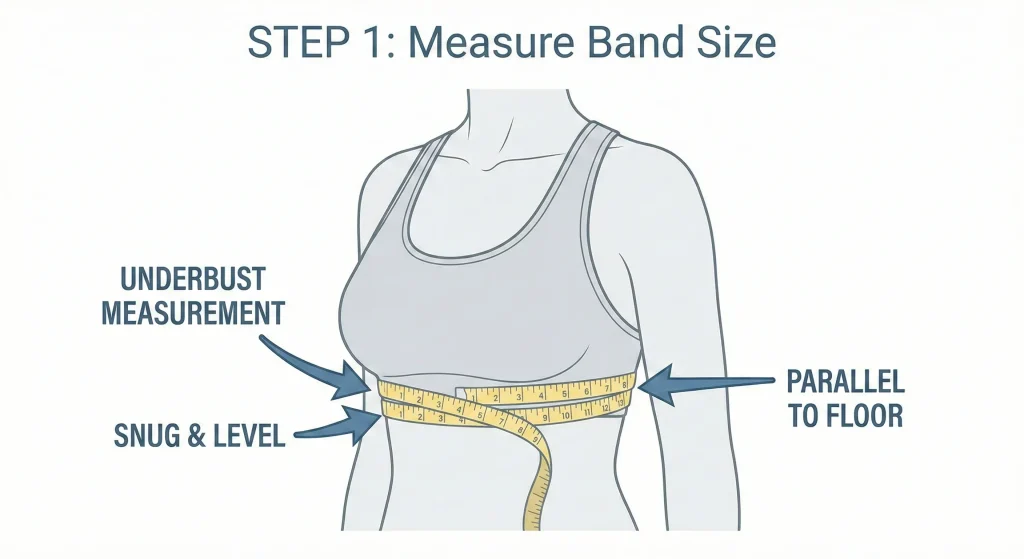
Step 1: Measure Your Band (Underbust)
This measurement helps determine your band size (the number part, like 32, 34, 36).
- Stand straight and relax your shoulders.
- Wrap the tape snugly around your ribcage, directly under your bust.
- Keep the tape parallel to the floor all the way around.
- Breathe out normally (don’t hold your breath).
- Write down the number in inches or cm.
Band measuring tips (quick):
- Snug means firm but not painful
- Don’t measure over clothing
- If the tape slips down your back, it’s probably too loose
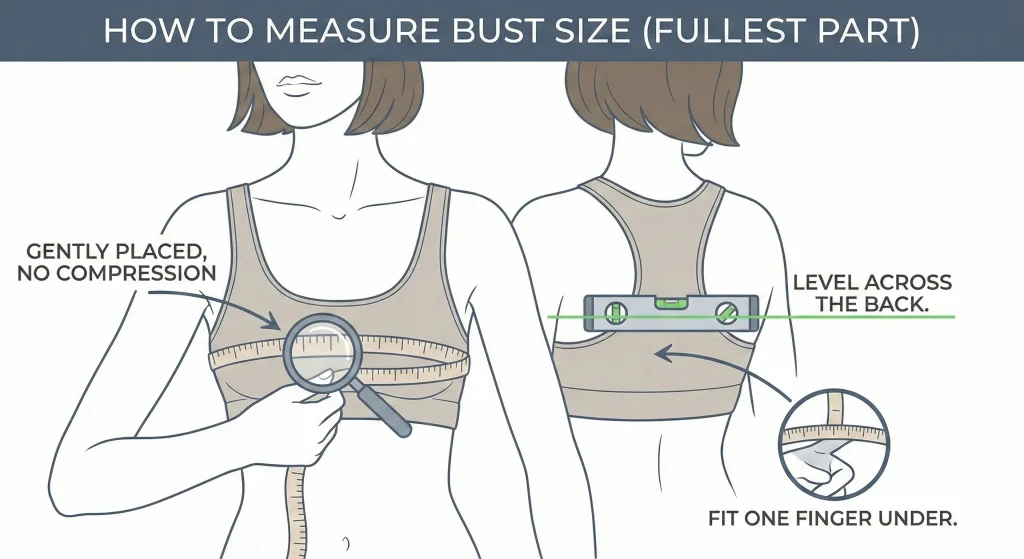
Step 2: Measure Your Bust (Fullest Part)
This measurement helps determine your cup size (the letter part, like C, D, DD).
- Wear a non-padded bra if possible.
- Wrap the tape around the fullest part of your bust (usually across the nipples).
- The tape should be comfortably placed, not digging in.
- Keep it level across your back.
- Write down the number in the same unit as your band measurement.
Bust measuring tips (quick):
- Don’t pull the tape tight — that can underestimate your bust
- Don’t measure over padded bras — that can overestimate
- Check in the mirror that the tape is level
Should You Measure in Inches or CM?
Either is fine. The UK uses both, and what matters most is consistency.
- If you measure your band in inches, measure bust in inches
- If you measure in cm, keep both in cm
Your results won’t be “more accurate” just because you used inches or cm — accuracy comes from tape placement and tension, not the unit.
What Do Bra Size Measurements Mean?
Your bra size has two parts:
- Band size (number) = based mainly on your underbust
- Cup size (letter) = based on the difference between bust and underbust
Important: Cup size is relative to band size.
That means a “D cup” isn’t one fixed volume — it changes depending on the band. This is why two people can both wear a “D cup” and look completely different.
That’s also why calculators are helpful: they turn raw measurements into a usable starting size, and then you can adjust for comfort and brand differences.

UK Bra Size Chart (Reference Only)
Use the charts below as a quick reference, not a replacement for a calculator. Real bodies, bras, and brands vary — so treat this as a starting guide.
UK Band Size Chart (Underbust → Band Size)
This chart gives a typical UK band size range based on underbust measurement.
Reference only: band sizing can vary slightly by brand and bra style.
| Underbust (in) | Underbust (cm) | Suggested UK Band Size |
|---|---|---|
| 26–27 | 66–69 | 28 |
| 28–29 | 71–74 | 30 |
| 30–31 | 76–79 | 32 |
| 32–33 | 81–84 | 34 |
| 34–35 | 86–89 | 36 |
| 36–37 | 91–94 | 38 |
| 38–39 | 97–99 | 40 |
| 40–41 | 102–104 | 42 |
| 42–43 | 107–109 | 44 |
| 44–45 | 112–114 | 46 |
| 46–47 | 117–119 | 48 |
UK Cup Size Chart (Bust − Underbust Difference → Cup Letter)
Cup letters typically follow the bust–underbust difference. UK brands commonly include DD, FF, GG, HH, JJ etc.
Reference only: cup lettering can vary by brand. Use this as a guide.
| Difference (in) | Difference (cm) | UK Cup |
|---|---|---|
| 1 | 2.5 | A |
| 2 | 5 | B |
| 3 | 7.5 | C |
| 4 | 10 | D |
| 5 | 12.5 | DD |
| 6 | 15 | E |
| 7 | 17.5 | F |
| 8 | 20 | FF |
| 9 | 22.5 | G |
| 10 | 25 | GG |
| 11 | 27.5 | H |
| 12 | 30 | HH |
| 13 | 32.5 | J |
| 14 | 35 | JJ |
| 15 | 37.5 | K |
Common Measuring Mistakes That Cause Wrong Sizes
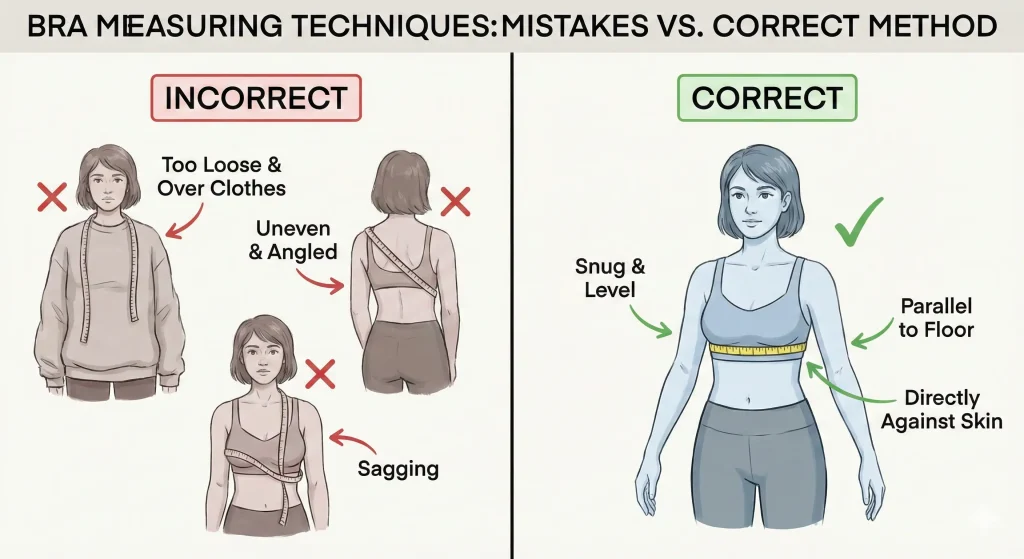
These are the biggest reasons people get a surprising result:
- Tape isn’t level (especially at the back)
- Band measured too loose (leads to bands that ride up)
- Bust tape pulled too tight (leads to cups that feel small)
- Measuring over padding
- Relying on a chart alone without checking fit
If your result feels “wrong,” it often isn’t your body — it’s the measurement method. Re-measure once carefully before assuming the calculator is incorrect.
What to Do After Measuring
Once you have your measurements:
- Calculate your UK starting size using your numbers.
- When you try bras, check the fit:
- band feels firm and level
- cups contain tissue without gaping/spilling
- straps support but don’t carry the weight
- If the fit is close but not perfect, use sister sizes to adjust the band while keeping a similar cup volume.