
How Accurate Are Bra Size Calculators?
A bra size calculator can give you a useful starting band and cup size, but it cannot guarantee that every bra carrying that size label will fit perfectly. That distinction is important.
A calculator works from measurements and applies a defined sizing method. An actual bra has to fit a real body, using cups, wires, fabrics and bands that vary between styles and brands.
So instead of asking: “Can a bra size calculator find my one perfect size?” a more useful question is: “Can it give me a sensible size to start trying?”
That is what our UK Bra Size Calculator is designed to do.
What Research Tells Us About Bra Fit
Poor bra fit is not simply a marketing claim. Researchers have repeatedly found high rates of incorrectly sized or poorly fitting bras in the groups they studied.
A 2008 study by Wood, Cameron and Fitzgerald found that 80% of the young women in its study sample were wearing incorrectly sized bras. Of the participants, 70% were assessed as wearing bras that were too small and 10% bras that were too large.
Another study by McGhee and Steele assessed 104 women and found that 85% were wearing ill-fitting bras according to the fitting criteria used by the researchers. The study also found significant differences between sizes selected through measurement or self-selection and sizes determined using professional fitting criteria.
Research conducted in the UK has also compared traditional measurement-based sizing with assessment of the way an actual bra fits. White and Scurr concluded that greater emphasis should be placed on assessing bra fit rather than relying solely on determining an absolute size.
Does this prove that “80% of women wear the wrong bra size”?
No. You may often see statements online claiming that a fixed percentage — commonly 80% — of all women wear the wrong bra size.
The research does not justify applying one percentage universally to every woman, every age group or the whole UK population.
Different studies have involved different:
- participant groups
- sizing methods
- bra styles
- fitting criteria
- age ranges
- definitions of correct fit
The evidence supports a more careful conclusion:
Incorrect bra sizing and poor bra fit have been found to be common in several studied populations.
That is different from claiming that exactly 80% of every woman wears the wrong size.
So, How Accurate Is a Bra Size Calculator?
There is no scientifically meaningful universal percentage that can be given for the accuracy of every online bra size calculator.
We therefore do not claim that our calculator is: “95% accurate” or “guaranteed to be within one size.” There are really two different types of accuracy to consider.
Calculation accuracy
A calculator can consistently apply a defined formula to the measurements entered. Our calculator uses your: actual underbust measurement and full bust measurement to determine a starting UK band and cup size.
The sizing method is publicly documented in our How This UK Bra Size Calculator Works guide.
This means you do not have to take a claim such as “advanced algorithm” on trust. You can see how the result is produced.
Fit accuracy
This is more complicated. Once you put on an actual bra, fit can depend on much more than two circumference measurements.
Two bras labelled 34DD can fit differently because of differences in:
- band stretch
- cup depth
- cup height
- wire width and shape
- fabric
- construction
- coverage
- overall bra style
So a mathematically consistent calculation does not guarantee identical real-world fit across every bra. That is why we describe the calculator result as a starting size.
What Our Calculator Uses to Estimate Your Size
The core size calculation is based on measurements rather than your existing bra label, clothing size, age or weight.
For the band, the calculator uses your actual underbust to determine a standard even-numbered starting UK band.
For example: 32.0″ underbust → 32 band while 32.1″ underbust → 34 band
For the cup calculation, it uses: Full bust − actual underbust The cup is not calculated by subtracting the rounded band label.
For example: Underbust: 31″ Full bust: 36″ The cup difference is 36 − 31 = 5″ A 5-inch difference corresponds to DD in the UK progression used by our calculator. The underbust produces a starting 32 band, giving: 32DD
Documenting this matters because a calculator’s accuracy cannot be evaluated properly if nobody knows how it reaches its answer.
Where Can a Bra Size Calculation Become Less Accurate?
Even when the sizing formula is applied consistently, uncertainty can enter before you ever reach the result.
Measurement technique matters
Your measurements are the calculator’s inputs. If the inputs change, the calculated size can change too.
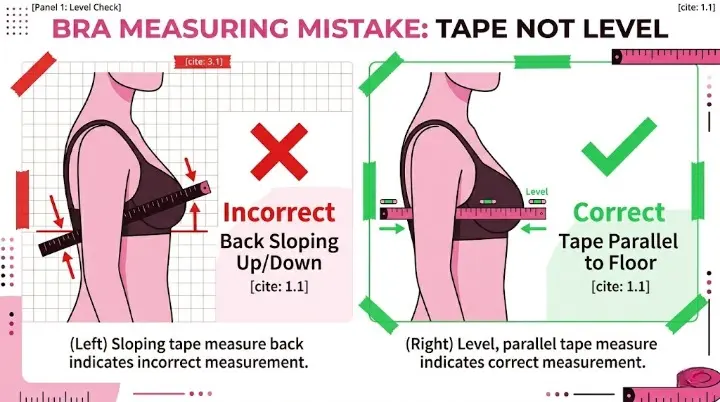
For example, your underbust measurement can differ if the tape is:
- held too loosely
- pulled unusually tight
- positioned too high or low or
- not kept level around your body
The full bust can also be affected if:
- the tape compresses breast tissue
- it misses the fullest point
- it is not horizontal or
- a heavily padded bra changes the measurement
Research has also found that measurement method and respiratory state can affect bra-size estimates.
For that reason, careful measurement is one of the simplest ways to improve the usefulness of a calculator result.
If you are unsure about your measurements, follow our How to Measure Bra Size guide and take each measurement more than once.
A Bra Size Is a Starting Label, Not a Complete Description of the Bra
Consider 34DD The label gives useful information about the relationship between the intended band and cup.
But it does not tell you:
- how firm the band is
- how projected the cup is
- how wide the wires are
- how much coverage the bra provides
- how stretchy the fabric is or
- how that particular design interacts with your body shape
That means two bras displaying the same size can feel different. This does not necessarily mean the size calculation was wrong. Sometimes the bra itself is the variable.
Breast Shape Can Affect Fit Without Changing Your Calculated Size
Two people can have the same underbust and full-bust measurements while having different breast shapes.
Their breast tissue might differ in:
- projection
- fullness
- width
- spacing
- distribution
That can influence which bra styles or cup constructions work better. This is why our calculator separates size calculation from shape-based style recommendations.
Your underbust and full bust determine the core band-and-cup calculation. Breast shape is used to help personalise the styles recommended alongside your result.
In our calculator testing, the same 32″ underbust and 37″ full-bust measurements produced 32DD with both Round and Bell shape selections. The size stayed the same because the body measurements stayed the same.
Shape helps with the next question:
What type of bra may work with this size and shape?
rather than changing the underlying calculated size.
Why Might the Calculator Give Me a Very Different Size?
Suppose you normally wear 36B but a calculation suggests something that looks very different, such as 32DD. It is easy to assume that one result must be wrong. But bra sizes do not work like ordinary clothing sizes. The band and cup are related. A cup letter cannot be interpreted properly without its band.
There are also several reasons why your calculated size may differ from your current bra.
Your current bra may not fit well
Research showing substantial levels of poor fit in studied populations is one reason we should not automatically use someone’s current bra label as proof of their correct size.
Your measurements may have changed
Body measurements are not permanent. Weight changes, hormonal changes, pregnancy and normal changes over time can alter measurements.
Your old bra may have stretched
A frequently worn band can behave differently from a new bra carrying the same size label.
Another sizing method may have been used
Not every retailer, fitter or calculator uses exactly the same method for determining a starting size.
The bra style may simply fit differently
A plunge, balconette and full-cup bra can interact differently with the same body even when the size label is unchanged. The most useful response to an unexpected calculator result is therefore not to immediately reject it.
Check the measurements, try the suggested starting size and then assess what the actual bra is doing.
The Biggest Limitation: A Calculator Cannot See You Wearing the Bra
This is the main limitation of any measurement-only calculator.
An online calculator cannot physically observe whether:
- the band rides up
- the cups overflow
- the cups gape
- wires sit on breast tissue
- the bra feels uncomfortable
- the centre of an underwired bra sits as intended
- the straps repeatedly fall down
- the particular cup shape works with your body
Those observations only become possible when an actual bra is being worn.
This creates two separate stages.
Stage 1: Calculate
Use measurements to establish a sensible starting size.
Stage 2: Check the fit
Put on the bra and assess the actual band, cups, wires and comfort.
Published UK research comparing traditional sizing with professional fitting criteria similarly supports placing more emphasis on assessing the fit of the actual bra rather than relying entirely on an absolute numerical size.
What About Sister Sizes?
Sometimes the calculated cup volume feels approximately right while the band does not.
That is where sister sizing can be useful.
For example: 32DD → 34D → 36C These sizes belong to a sister-size progression. However, sister sizes should not be treated as three identical bras.
Changing the band changes how the bra tensions around the body, while the cup letter changes to maintain a related cup volume.
Sister sizing is therefore a way of making a controlled adjustment, not proof that every size in the progression will fit equally well.
See our Bra Sister Sizes guide for the full explanation.
How to Get a More Useful Calculator Result
You do not need dozens of measurements or complicated calculations. Good inputs and sensible fit checking are more useful. Measure your underbust and full bust carefully.
If a measurement looks unusual, take it again rather than changing the number to match the size you expected. Then start with the calculated band and cup. When trying the bra, assess the band and cups separately.
If the band feels wrong while the cup volume seems close, consider a sister-size adjustment.
If the result is very different from what you normally wear, first check the measurements before assuming that either the calculator or your existing bra must be wrong.
Is a Professional Bra Fitting More Accurate Than a Calculator?
A calculator and a fitter can perform different roles. A calculator can take measurements and apply the same sizing method consistently. A knowledgeable fitter can additionally observe the way a particular bra sits on your body.
That includes things a measurement-based calculator cannot see, such as cup shape, wire position, band behaviour and how the bra feels when worn.
Research comparing measurement methods with professional fitting criteria has found meaningful differences between size calculation and fit-based assessment.
That does not make a calculator useless. It means the two approaches solve different parts of the problem.
A calculator can answer:
“What size should I start with?”
Trying the bra — either yourself or with fitting assistance — answers:
“Does this particular bra actually fit me?”
Why We Call the Result a “Starting Size”
We use the phrase starting size deliberately. It means:
The band-and-cup combination produced by our documented sizing method from the measurements you entered.
It does not mean:
The only bra size you can ever wear.
And it does not mean:
Every bra carrying that label will fit perfectly.
No honest measurement-based calculator should promise that.
Our Approach to Bra Size Calculator Accuracy
We prefer transparency over publishing an unsupported accuracy percentage.
Rather than saying our calculator is “99% accurate” or “expert-perfect”, we show you:
- which measurements it uses
- how the starting band is selected
- how the cup difference is calculated
- which UK cup progression is used
- how centimetres and inches are handled
- what breast shape affects
- what breast shape does not affect
- where measurement error can occur
- why real-world bra fit may differ from a calculated result
You can read the complete calculation process on our UK Bra Size Calculator Methodology page.
That makes the result understandable and testable rather than asking you to trust a black-box calculation.
Research Referenced
The evidence discussed on this page includes the following published studies:
Wood K, Cameron M, Fitzgerald K. (2008).
Breast size, bra fit and thoracic pain in young women: a correlational study. The study reported incorrectly sized bras in 80% of its sample of young women. View source
McGhee DE, Steele JR. (2010).
Optimising breast support in female patients through correct bra fit: a cross-sectional study. The researchers assessed 104 women and reported ill-fitting bras in 85% of participants. View Source
White J, Scurr J. (2012).
Evaluation of professional bra fitting criteria for bra selection and fitting in the UK. The study compared traditional bra sizing with professional fitting criteria in an underwired bra commonly sold in the UK. View Source
McGhee DE, Steele JR. (2006).
How do respiratory state and measurement method affect bra size calculations? The research found that measurement method and respiratory state affected bra-size estimates.
These studies do not prove that one universal percentage of women wears the wrong bra size, nor do they validate the accuracy percentage of our calculator.
They do support the broader point that bra sizing and real-world bra fit are not always the same thing.
Calculate Your Starting UK Bra Size
If you have your underbust and full bust measurements, use our Bra Size Calculator UK to calculate your starting UK band and cup size. Use the result to narrow down where to begin, then judge the fit of the actual bra. That is the role the calculator is designed to perform.