
How UK Bra Sizes Work | Band & Cup Size Guide
SEO Title: How UK Bra Sizes Work | Band & Cup Size Guide
Meta Description: Learn how UK bra sizes work, including band sizes, cup progression, bust differences, sister sizes and why the same cup letter changes with band size.
How UK Bra Sizes Work
A UK bra size has two parts: a band size and a cup size.
For example, in 34DD:
- 34 is the band size.
- DD is the cup size.
The two parts work together. A cup letter on its own does not describe a complete bra size, and the same cup letter can represent different cup volumes on different band sizes.
Understanding this relationship makes it much easier to interpret a calculated bra size, use a UK size chart and understand sister sizes.
If you already know your underbust and full bust measurements, you can use our UK Bra Size Calculator to estimate your starting size automatically.
The Two Parts of a UK Bra Size
A UK bra size combines:
Band size + cup size = complete bra size
Examples include:
- 30D
- 32DD
- 34E
- 36F
- 38FF
The band relates to the measurement around your ribcage underneath your bust.
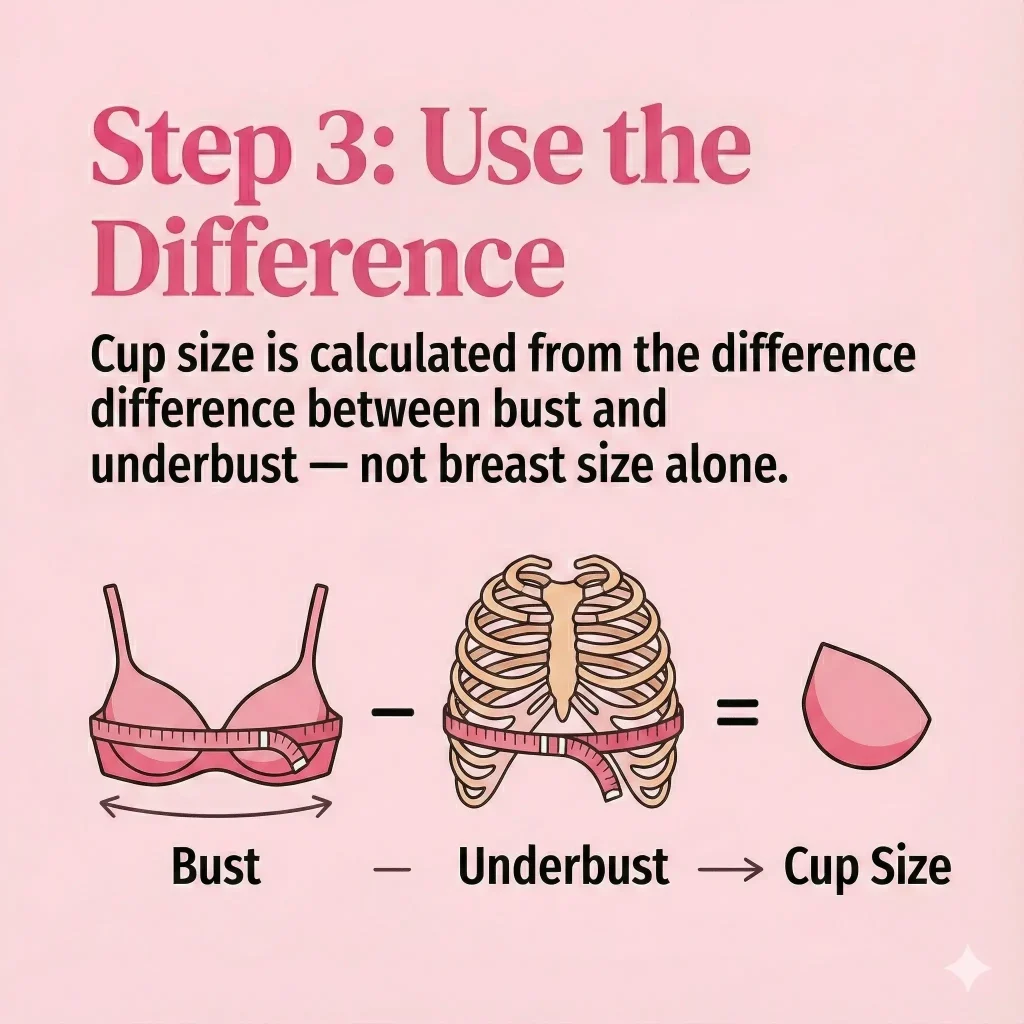
The cup relates to the difference between your full bust measurement and your actual underbust measurement.
Neither part should be interpreted completely on its own.
For example, saying that someone is “a D cup” does not give enough information to describe their bra size. A 30D, 34D and 38D all use the letter D, but they do not have identical cup volumes.
What Does the Band Size Mean?
The band is the numbered part of a UK bra size.
Common UK band sizes include:
28 → 30 → 32 → 34 → 36 → 38 → 40 → 42 → 44
Band labels normally progress in even-numbered steps.
Your underbust measurement is the physical measurement around your ribcage directly underneath your bust. Your labelled band size is the bra size selected from the available band progression.
These two numbers are related, but they are not always identical.
How Our Calculator Determines a Starting Band Size
For consistency, our calculator converts the underbust measurement to the next standard even-numbered band when necessary.
For example:
Actual Underbust | Starting Band |
|---|---|
30″ | 30 |
30.5″ | 32 |
31″ | 32 |
32″ | 32 |
32.1″ | 34 |
33″ | 34 |
34″ | 34 |
So an underbust measurement of exactly 32 inches starts with a 32 band, while a measurement slightly above 32 inches moves to the next standard band, 34.
This is the method used by our calculator to produce a consistent starting size. Real-world fitting can differ between brands, bra constructions, fabrics and personal preferences, so the calculated band should be treated as a starting point rather than a guarantee that every bra with that label will fit identically.
If you are not sure how to take your underbust measurement, see our How to Measure Bra Size guide.
What Does the Cup Size Mean?
The cup is the letter part of a UK bra size.
Examples include: B, C, D, DD, E, F, FF and G
In our starting-size calculation, the cup is estimated from the difference between:
Full bust measurement − actual underbust measurement
Importantly, this uses the actual underbust measurement, not the rounded band label.
For example:
Underbust: 31 inches
Full bust: 36 inches
Difference: 36 − 31 = 5 inches
A 5-inch difference corresponds to a starting DD cup in our calculation.
The underbust of 31 inches is converted separately to a 32 band.
The estimated starting size therefore becomes:
32DD
This distinction matters because subtracting the rounded 32 band from the 36-inch bust would give a different difference. Our calculator keeps the band calculation and cup calculation separate.
Bust Difference and Starting UK Cup Size
Our calculator uses the following starting cup progression:
Bust − Actual Underbust Difference | Starting Cup |
|---|---|
1″ | A |
2″ | B |
3″ | C |
4″ | D |
5″ | DD |
6″ | E |
7″ | F |
8″ | FF |
9″ | G |
10″ | GG |
For example:
A 4-inch difference gives a starting D cup.
A 5-inch difference gives a starting DD cup.
An 8-inch difference gives a starting FF cup.
You can see these relationships laid out by band size in our UK Bra Size Chart.
UK Cup Size Progression
One of the most important things to understand about UK bra sizing is that cup letters do not simply continue through the alphabet one letter at a time.
A common UK cup progression is:
A → B → C → D → DD → E → F → FF → G → GG → H → HH → J → JJ → K → KK → L
The exact upper size range available varies between bra brands, but the use of double-letter cups such as DD, FF and GG is an important feature of UK sizing.
This is also one reason UK cup sizes should not automatically be treated as equivalent to US or European cup labels.
Why Does the UK Use DD, FF and GG?
Double letters are part of the progression used in UK bra sizing.
For example: D → DD → E
and later: F → FF → G → GG
A DD cup therefore sits between D and E in the UK progression.
Similarly, FF sits between F and G.
This can be confusing if you are used to another sizing system because different countries and brands may use different cup sequences.
The safest approach when buying internationally is to identify which sizing system a brand uses and then convert the complete size rather than comparing cup letters alone.
See our UK vs US vs EU Bra Sizes guide for a more detailed comparison.
How Band and Cup Combine to Make a UK Bra Size
The final starting size comes from two calculations:
Step 1: Determine the Band
Use the actual underbust measurement to determine the appropriate starting band.
Step 2: Determine the Cup
Subtract the actual underbust measurement from the full bust measurement.
Then match the difference to the UK cup progression.
Finally: Band + cup = estimated UK starting size
Example 1: 31″ Underbust and 36″ Bust
Underbust: 31″
Starting band: 32
Full bust: 36″
Cup difference: 36 − 31 = 5″
5-inch difference: DD
Estimated starting size: 32DD
Example 2: 34″ Underbust and 38″ Bust
Underbust: 34″
Starting band: 34
Full bust: 38″
Difference: 38 − 34 = 4″
4-inch difference: D
Estimated starting size: 34D
These examples show why it is important to keep the actual underbust measurement separate from the labelled band when calculating the cup difference.
Why Cup Size Changes With Band Size
A common misunderstanding is that a cup letter represents one fixed breast or cup volume.
It does not. Consider: 30D 34D 38D
All three sizes use the letter D, but the cup volume increases as the band size increases.
This means:
D cup is not one fixed physical size.
The cup letter describes a cup size in relation to its band.
That is why the complete bra size matters.
A 30D and a 38D should not be treated as equivalent simply because both contain the letter D.
Why “I’m a D Cup” Isn’t a Complete Bra Size
You may often hear someone say:
“I’m a D cup.”
But in UK bra sizing, the cup letter alone is incomplete.
For example:
- 30D
- 32D
- 34D
- 36D
- 38D
are five different complete bra sizes.
The band changes the scale of the cup.
So it is more accurate to describe the full size, such as 34D, rather than the cup letter alone.
This is also why judging whether a cup letter sounds “large” or “small” without knowing the band size can be misleading.
How Sister Sizes Work
Because cup volume changes with band size, it is possible for different band-and-cup combinations to have similar cup volumes.
These are called sister sizes.
As a general concept, moving up one band size usually means moving down one cup step to maintain a similar cup volume.
For example:
32DD → 34D → 36C
These sizes use different band and cup labels, but they sit within the same sister-size progression.
Likewise, moving to a smaller band normally means moving up a cup step.
Sister sizing can be useful when the cups feel approximately right but the band feels too tight or too loose.
For full charts and examples, see our UK Bra Sister Sizes guide.
A Cup Letter Does Not Tell You Breast Size by Itself
Bra sizing is based on the relationship between measurements rather than assigning a single absolute breast size to each cup letter.
That means someone wearing 30F and someone wearing 38F do not necessarily have the same breast volume simply because both sizes use an F cup.
Similarly, moving from C to D does not mean exactly the same physical change across every possible band.
This relative relationship between band and cup is one of the most important ideas to understand when learning how UK bra sizes work.
UK Bra Sizes vs US and EU Bra Sizes
UK, US and European bra sizing systems are related, but they are not interchangeable.
The band labels may use different units or numbering conventions, and cup progression can also differ.
This becomes particularly noticeable after D cup because UK sizing commonly includes:
DD, E, F, FF, G, GG…
while another sizing system may use different letters for comparable sizes.
For that reason:
34DD UK does not automatically mean 34DD in every other sizing system.
Always check the sizing system used by the bra or retailer.
Our UK vs US vs EU Bra Sizes guide explains the differences in more detail.
How This Relates to Our Bra Size Calculator
Our calculator separates the sizing process into two parts.
First, it converts your actual underbust measurement into a standard even-numbered starting band.
Second, it calculates: Full bust − actual underbust to estimate the cup step.
For example:
31″ underbust + 36″ bust becomes:
Band: 32
Cup difference: 5″
Cup: DD
Starting result: 32DD
This is intended to give you a consistent starting UK size, not to guarantee that every bra in that size will fit exactly the same way.
Bra construction, fabric, brand sizing and individual body shape can all affect real-world fit.
For more detail about the calculation itself, see How This UK Bra Size Calculator Works.
UK Bra Sizing FAQs
What does the number in a UK bra size mean?
The number is the band size.
Common examples include 30, 32, 34, 36 and 38.
It relates to the measurement around the ribcage underneath the bust and identifies the labelled band used as part of the complete bra size.
What does the letter in a UK bra size mean?
The letter is the cup size.
In our calculation, it is estimated from the difference between the full bust and actual underbust measurements.
A larger difference generally moves further through the UK cup progression.
What comes after D in UK bra sizes?
The common UK progression continues:
D → DD → E → F → FF → G → GG
So DD comes immediately after D, followed by E.
Is DD bigger than D?
Within the same band size, yes.
For example, 34DD is one cup step above 34D.
But cup letters should always be considered together with the band because a DD cup on one band does not represent exactly the same cup volume as DD on every other band.
Is a D cup always the same size?
No.
Cup size is relative to band size.
A 30D, 34D and 38D all use the same letter but represent different complete sizes and different cup volumes.
Why are there no odd UK band sizes such as 33 or 35?
Standard UK bra band labels generally progress in even-numbered steps, such as:
30 → 32 → 34 → 36
A physical underbust measurement can fall between these numbers, which is why it has to be mapped to an available starting band size.
Are UK and US bra cup sizes the same?
Not always.
The systems can use different cup progressions, especially after D. Compare the complete size using the relevant sizing system rather than assuming the same cup letter means the same thing.
What if my calculated bra size looks very different from what I normally wear?
That does not automatically mean the calculation is wrong.
Different measuring methods, old sizing habits, brand differences and bra construction can all influence the size someone currently wears.
Treat the calculated result as a starting point and assess the actual fit of the bra.
Calculate Your UK Bra Size
Once you understand how the band and cup work together, you can calculate your starting size from your own measurements.
Enter your underbust and full bust measurements into our Bra Size Calculator UK to estimate your UK band and cup size automatically.